Impression, Sunrise
The story
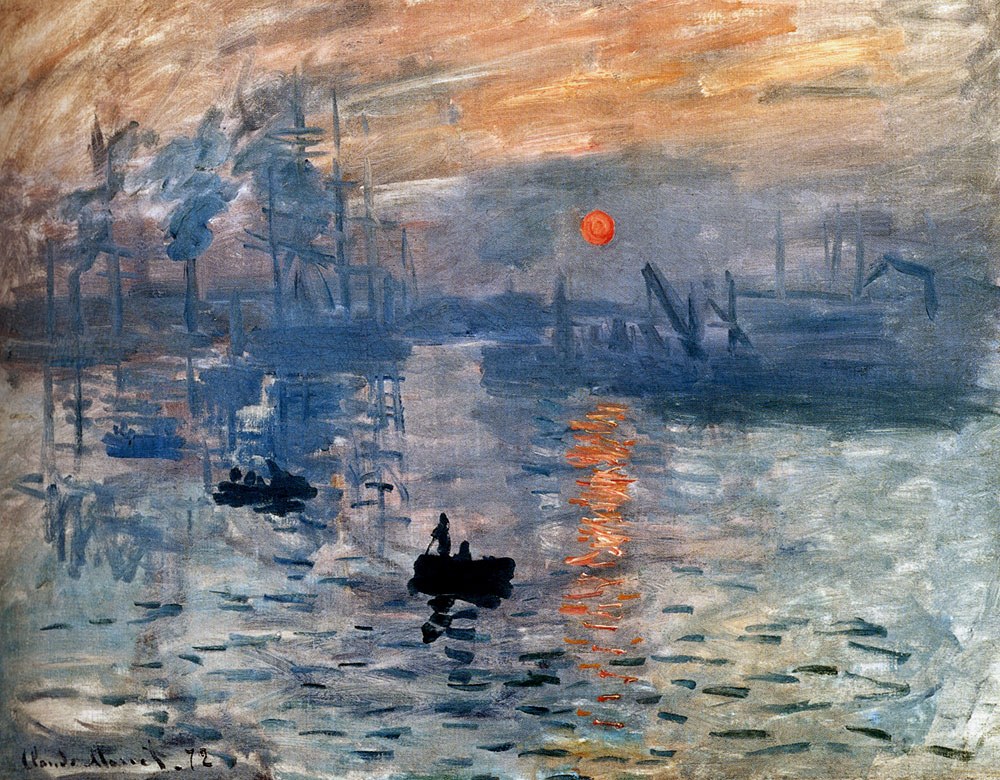
“Impression, Sunrise” is the painting that gave its name to an entire movement in art. Claude Monet painted it in 1872 in Le Havre, the port town where he grew up. He looked from the window of his hotel towards the harbour early in the morning, when the mist had not yet lifted. He painted quickly, as if he wanted to catch a moment that would vanish a minute later.
In “Impression, Sunrise” everything is grey-blue: water, sky, mist. Only the sun is a small orange disc, and below it an orange path of light runs across the water. In front, three small boats float, dark as shadows. In the distance cranes, masts and chimneys are barely visible. There is not a single clear line. Claude Monet paints not the harbour but the impression of it.
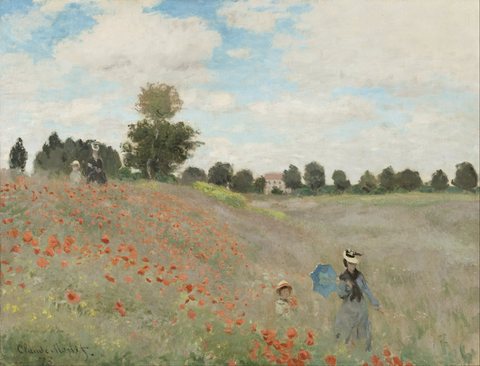
In April 1874 Claude Monet showed the painting at the group's first exhibition in Paris. They say that when he was asked how to list it in the catalogue, he answered: “Put Impression.” The critic Louis Leroy wrote a mocking article and called all the exhibitors “Impressionists”. The same exhibition included The Poppy Field near Argenteuil. The mockery remained forever as the name of the movement.
The painting was bought by the doctor and collector Georges de Bellio, a friend of the artists. His daughter gave it to the Musée Marmottan in Paris in 1940. In 1985 “Impression, Sunrise” was stolen from the museum together with other paintings. It was found only in 1990 in Corsica.
Today “Impression, Sunrise” is in the Musée Marmottan Monet in Paris. Claude Monet would paint hundreds more mornings and sunsets, but this small painting remains the beginning: one moment of light above the water that gave its name to an entire era.
Interesting facts
The canvas measures 48 × 63 cm, oil.
In 2014 researchers calculated from the position of the sun that Monet painted it on 13 November 1872, at about 7:35 in the morning.
The sun is almost as bright as the sky around it. In a black-and-white photograph it almost disappears.