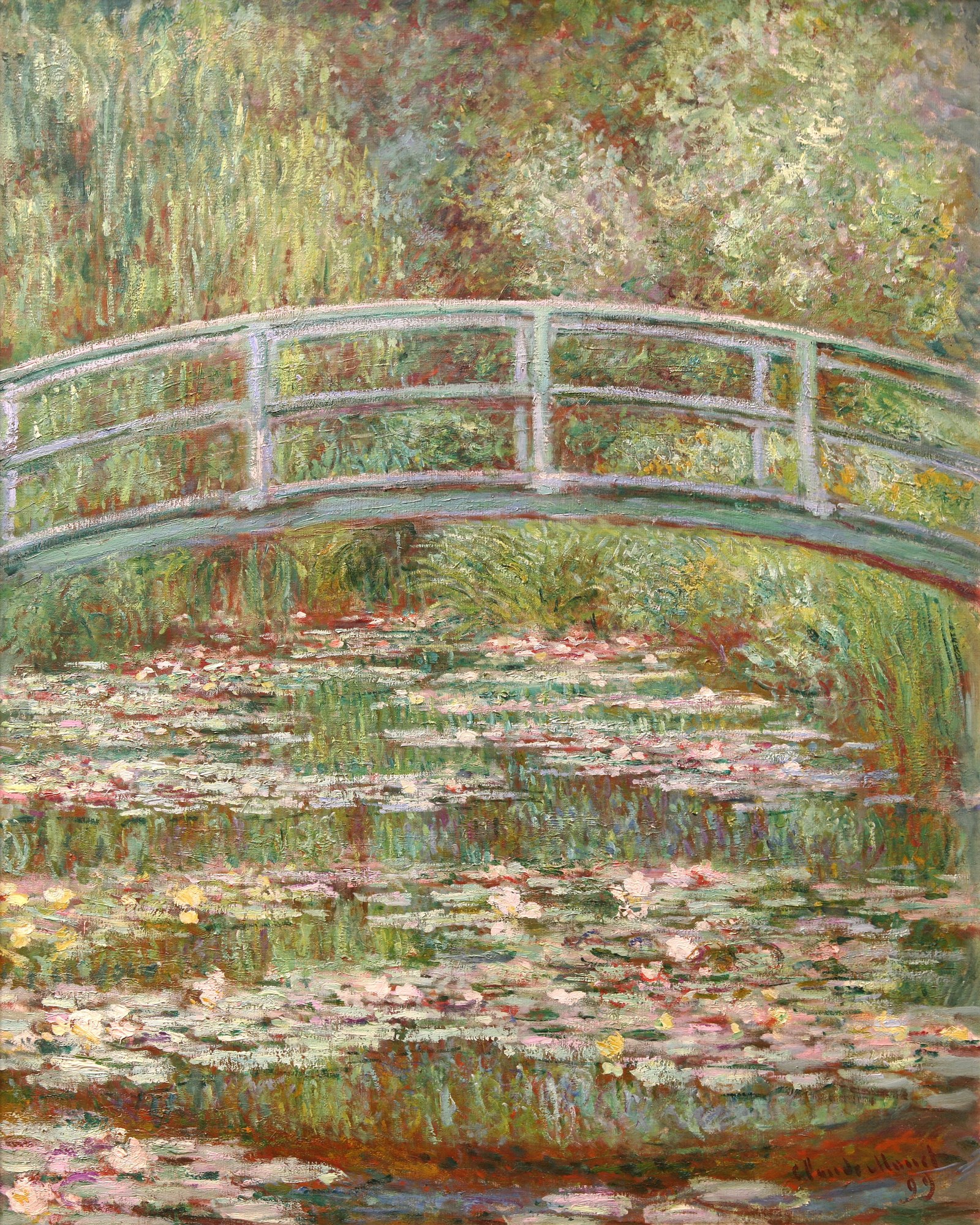
Bridge over a Pond of Water Lilies
The story
“Bridge over a Pond of Water Lilies” was painted in 1899 in the garden of Claude Monet in Giverny. In 1893 he bought a plot of land across the road and the railway in front of his house, dug a pond and diverted into it the water of a small stream. The neighbours feared that his strange plants would poison the water, but he received permission.
In “Bridge over a Pond of Water Lilies” a green wooden bridge arches over the water like a rainbow. Beneath it float water lilies, white, pink and yellow, and around the pond grow willows, bamboo and grasses. The sky is not visible. The whole picture is water, leaves and reflections.
Monet collected Japanese prints, and the bridge was built like the ones in the prints. In 1899 Claude Monet painted the bridge about 12 times, and in 1900 the dealer Durand-Ruel showed them in Paris. Every morning his gardeners cleaned the pond from a boat so that the lily leaves would stay clean.
The bridge became the beginning of something much bigger. Over the years Claude Monet painted only the water and the flowers ever more closely, until in the end no horizon or bank remained. This led to the great panels such as Water Lilies, Clear Morning with Willows.
Today “Bridge over a Pond of Water Lilies” is in the Metropolitan Museum of Art in New York. The collectors Havemeyer bequeathed it to the museum in 1929. Claude Monet said that the garden was his most beautiful work, and this painting is like a window into it.
Interesting facts
The canvas measures 92.7 × 73.7 cm, oil.
In 1899 Monet painted the Japanese bridge about 12 times.
The bridge in Giverny has been restored, and today visitors walk across it.