Women in the Garden
The story
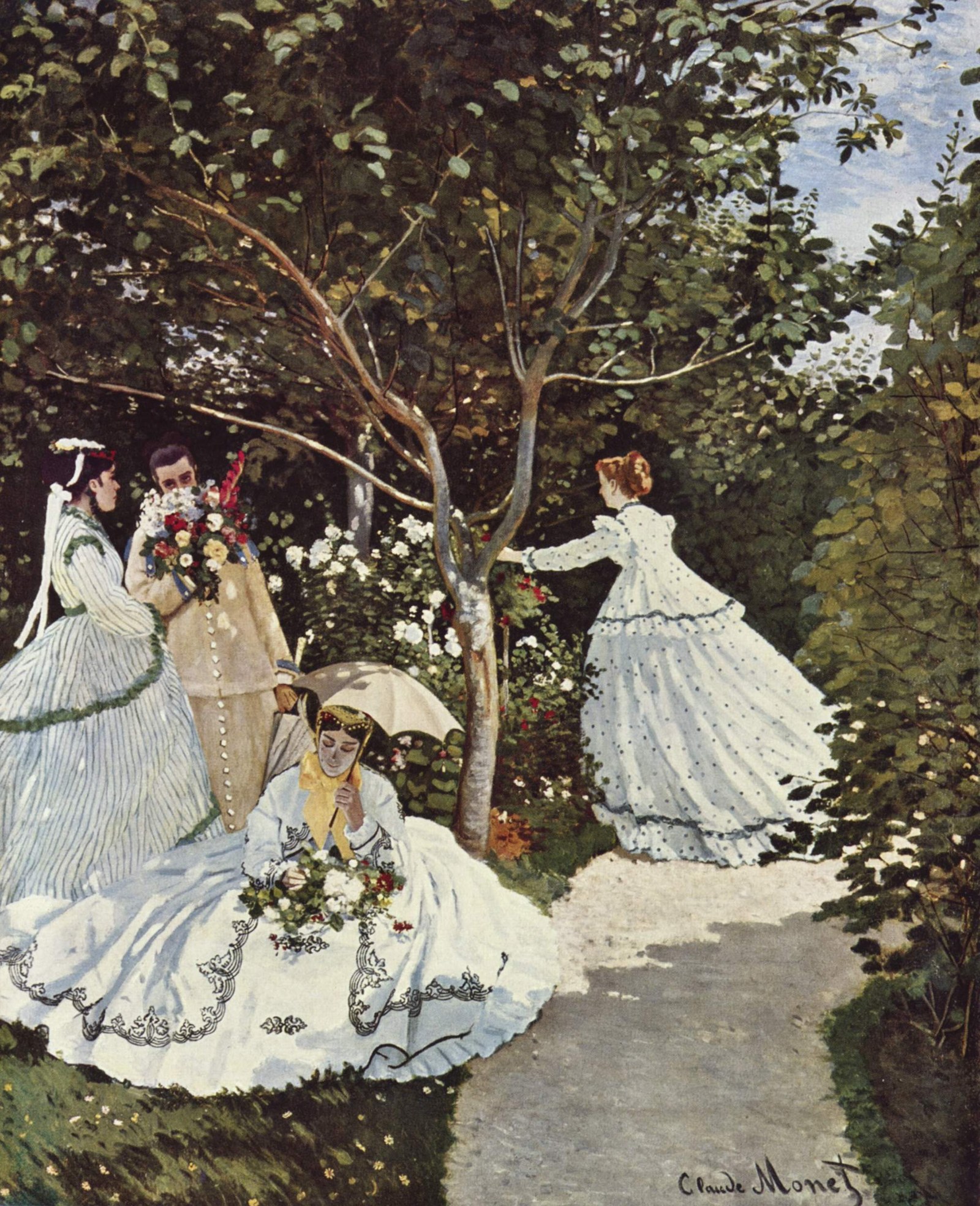
“Women in the Garden” is a painting with which Claude Monet took a great risk. In 1866, in the garden of a house in Ville-d'Avray near Paris, he decided to paint life-size figures entirely outdoors, in the sun. Until then such large paintings were made in the studio. The canvas is taller than a person.
In “Women in the Garden” four women in light dresses stand among flowering bushes. The sun falls through the leaves and makes the shadows blue, while the white dresses shine. One woman hides her face behind a parasol, another smells a bouquet. For most of the figures the model was Camille, the young woman Claude Monet loved.
To paint the upper part of the huge canvas without climbing a ladder, Monet dug a trench in the garden and lowered the picture into it with pulleys. He painted only when the sun was shining. They say that the painter Gustave Courbet found him standing idle and asked why he was not painting. Monet replied that he was waiting for the sun.
In 1867 the Salon jury rejected “Women in the Garden”. Claude Monet had no money, and Camille would soon give birth. His friend Frédéric Bazille bought the painting for 2500 francs and paid in monthly instalments to help him. Around the same time Monet also painted Le Déjeuner sur l'Herbe, Central Panel, and a few years later The Luncheon, with Camille and their little son Jean.
Today “Women in the Garden” is in the Musée d'Orsay in Paris. The French state bought it from Claude Monet himself in 1921. The painting rejected by the Salon is today considered one of the first great works of Impressionism.
Interesting facts
The canvas measures 255 × 205 cm, oil.
The Salon jury rejected the painting in 1867.
Frédéric Bazille bought the painting for 2500 francs, paid in instalments.