The Poppy Field near Argenteuil
The story
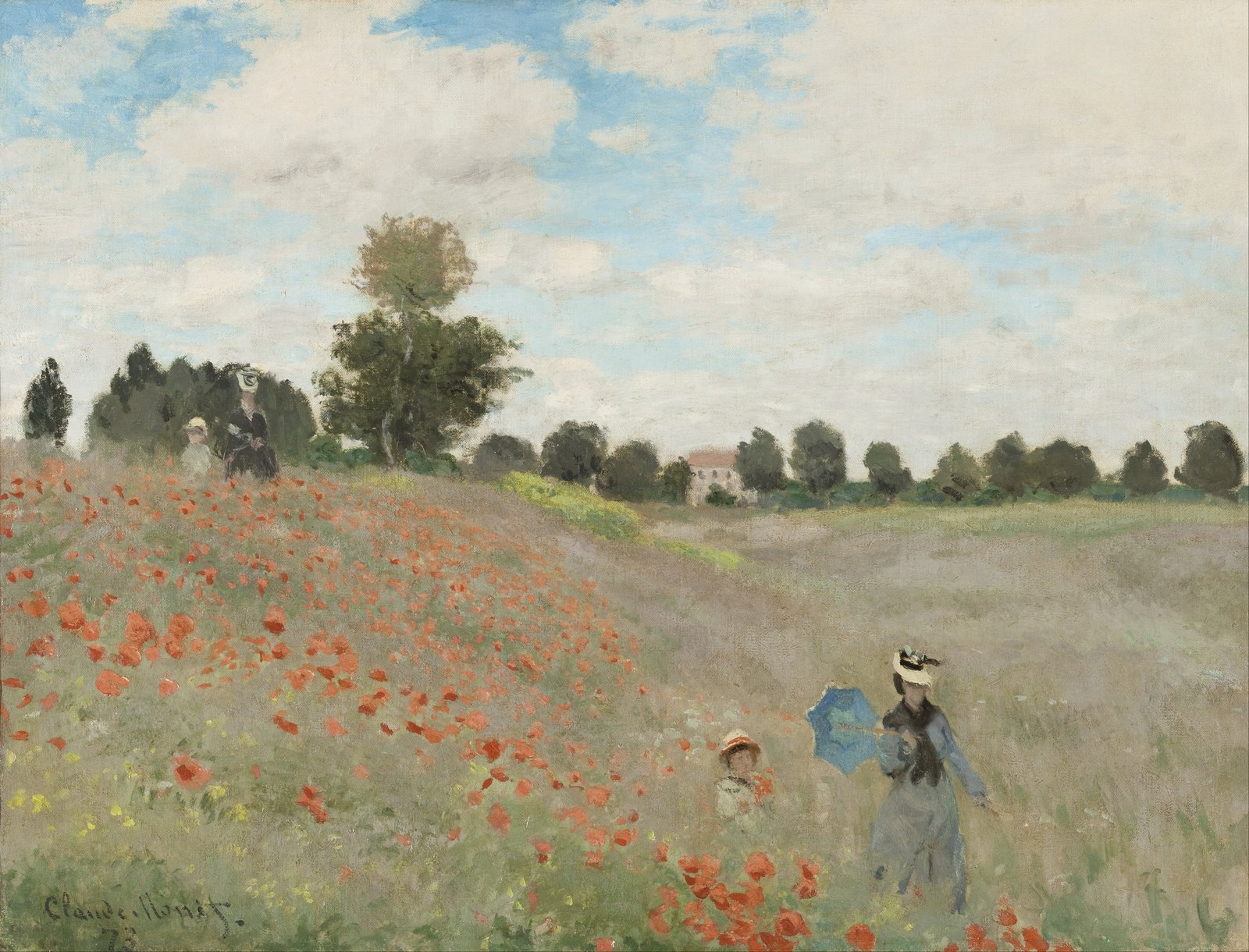
“The Poppy Field near Argenteuil” was painted in the summer of 1873. Claude Monet was living then in Argenteuil, a small town on the Seine near Paris, where he spent some of the happiest years of his life. Around him were fields, the river, boats and summer light, and he painted almost everything he saw.
In “The Poppy Field near Argenteuil” the hillside is covered with red poppies. Each flower is just one red dot, but together they sway as if in the wind. In front, a woman with a parasol and a little boy walk through the grass. Higher up the slope there is another pair, a woman with a parasol and a child. Most scholars believe that the woman is Camille and the boy their son Jean.
Claude Monet does not paint details. The poppies in front are larger, and further up they become ever smaller spots, and so the eye feels the depth by itself. The sky is bright, with white clouds, and the two pairs are linked by a diagonal that leads the eye up the slope.
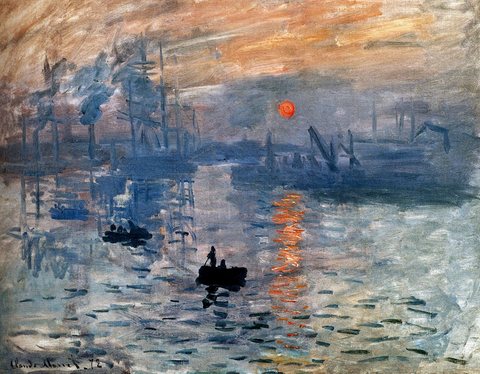
In April 1874 the painting was shown at the first Impressionist exhibition together with Impression, Sunrise. In Argenteuil Claude Monet also built himself a small boat with a cabin, from which he painted the river: The Studio Boat. Years later, in Giverny, he would paint poppy fields again.
Today “The Poppy Field near Argenteuil” is in the Musée d'Orsay in Paris. The collector Étienne Moreau-Nélaton gave it to the state in 1906. It is one of the best-loved paintings of Claude Monet: an ordinary summer walk turned into a memory that does not fade.
Interesting facts
The canvas measures 50 × 65 cm, oil.
The painting was shown at the first Impressionist exhibition in 1874.
Étienne Moreau-Nélaton gave it to the French state in 1906.