Self-Portrait with a White Hat
The story
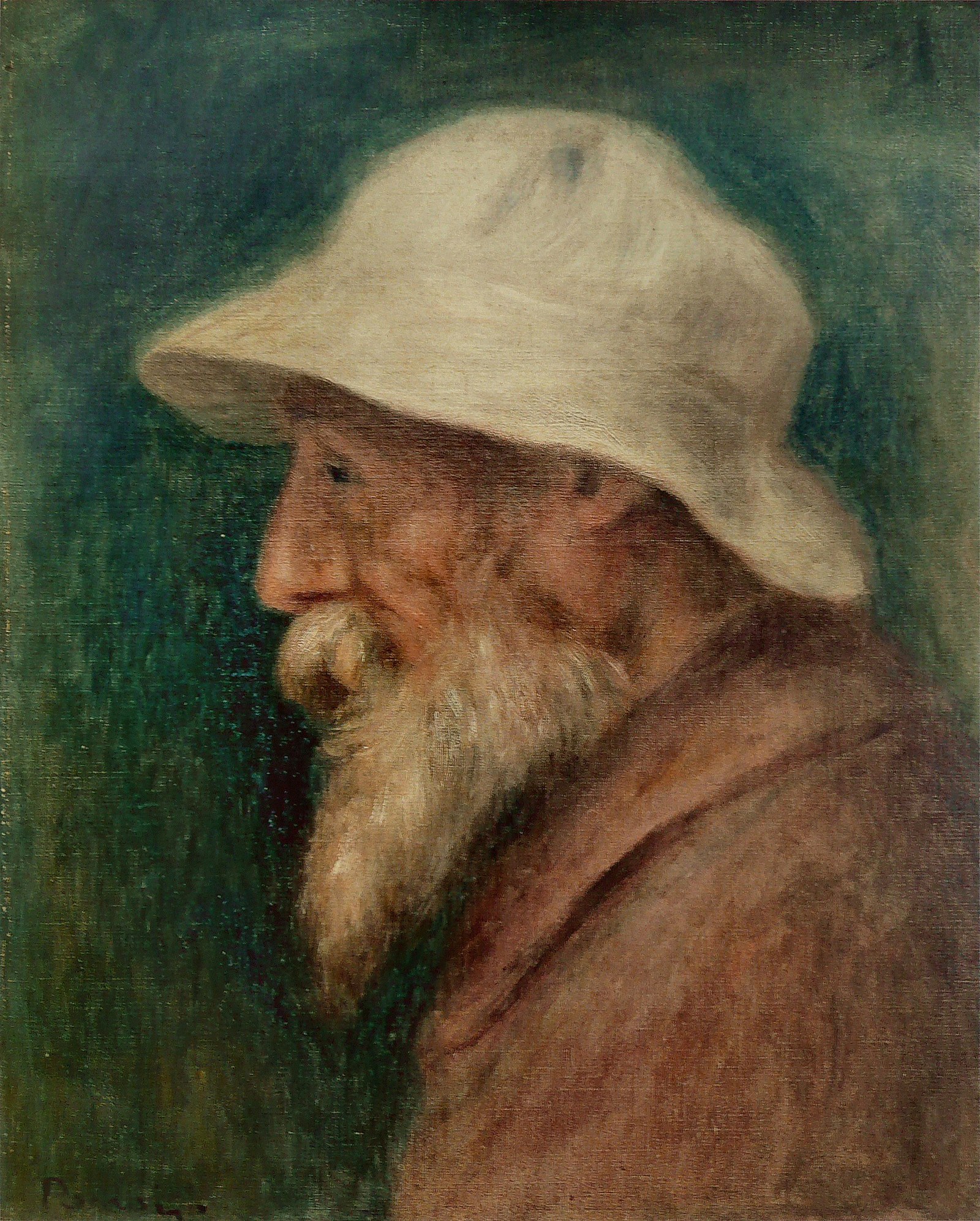
Self-Portrait with a White Hat shows an old man in profile, quiet and turned inward. The year is 1910. Pierre-Auguste Renoir is sixty-nine. He no longer lives in Paris but in the south of France, in Cagnes-sur-Mer, in a house among old olive trees called Les Collettes. The light there is warm and soft, and he paints almost every day.
Look closely at the face in Self-Portrait with a White Hat. The white beard falls onto the brown coat, the cheek is pink and warm, the eye is half hidden under the brim. The hat is painted with a few broad, creamy strokes and glows like a small cloud against the dark green background. There is no room, no furniture, no story. Only a man and the light on him.
Behind this calm lies a hard truth. By then the hands of Pierre-Auguste Renoir were twisted by rheumatoid arthritis, and every step cost him effort. It is said that the brush was placed between his stiff fingers and that he went on painting regardless. In Self-Portrait with a White Hat there is no complaint. The artist looks ahead, not at us, as if he were already thinking about the next picture.
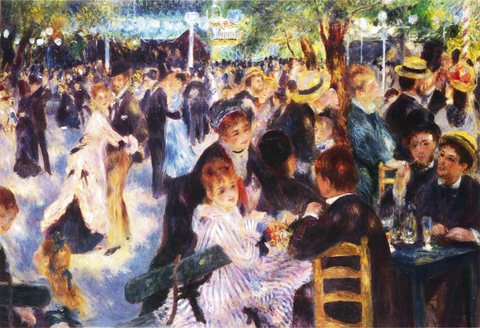
Compare it with Bal du moulin de la Galette, painted thirty-four years earlier, when Renoir was young and Montmartre danced around him. There the light leaps from face to face. Here it rests quietly on a single face. The same painter, the same love of light, only older and calmer.
Pierre-Auguste Renoir kept painting until the last days of his life, in 1919. Self-Portrait with a White Hat is one of the portraits he made of himself in old age: honest, without self-pity, painted by a man who would not let illness take his work away.
Interesting facts
The canvas is small, 42 × 33 cm, painted in oil.
Self-Portrait with a White Hat is in a private collection and is rarely shown to the public. In 2014 it was exhibited at the Fondation Pierre Gianadda in Martigny, Switzerland.
The signature "Renoir" is in the lower left corner of the painting.