La Loge
The story
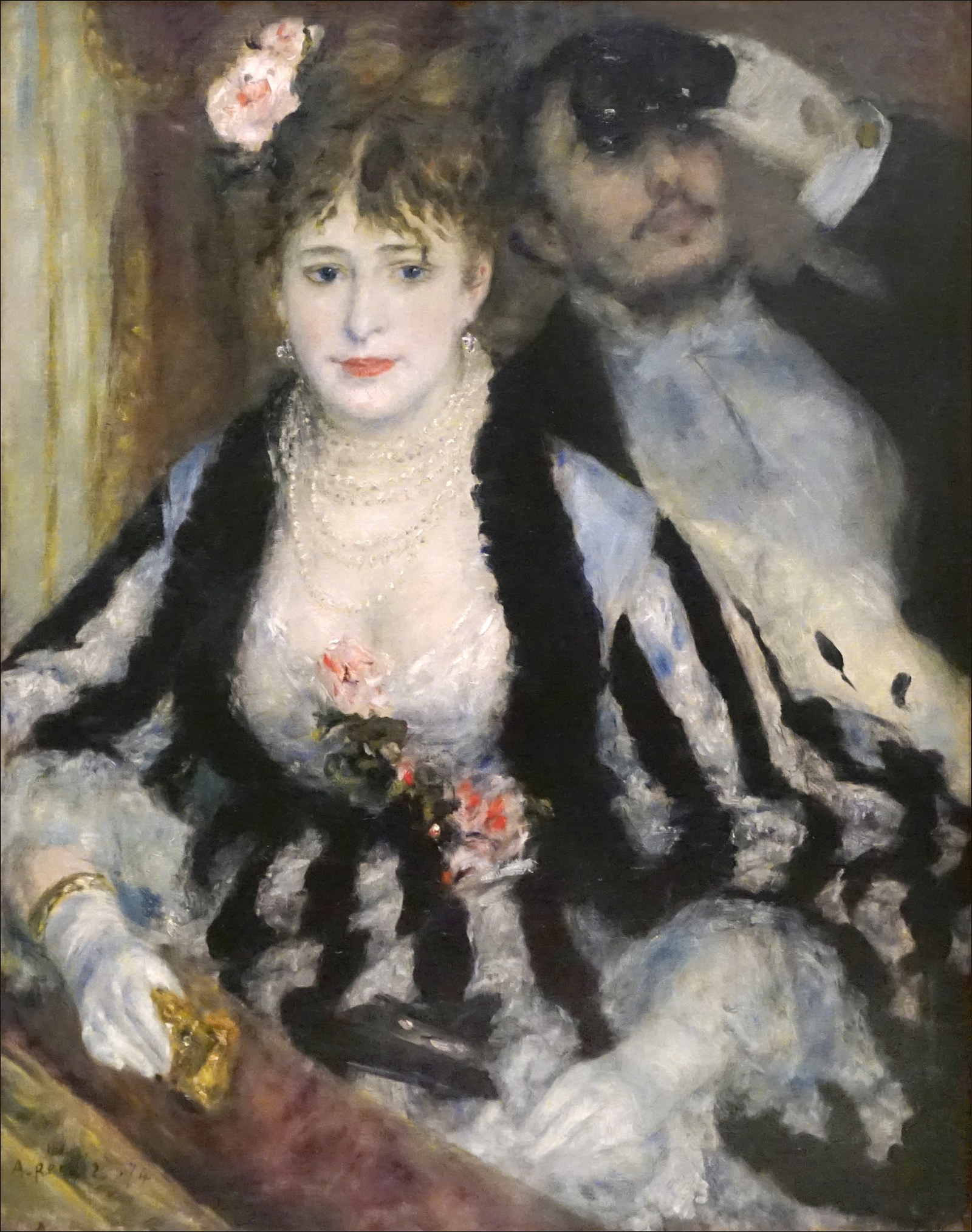
La Loge takes us into a Paris theatre in the moment before the curtain rises. Two people sit in a narrow box. The woman wears a dress with black and white stripes, pearls shine at her throat, and there are roses in her hair and at her breast. She looks calmly ahead, as if she knows everyone is looking at her. The man behind her has raised his opera glasses, not towards the stage but upwards, towards the other boxes. In the nineteenth-century theatre the audience came not only to watch but to be watched.
Pierre-Auguste Renoir painted La Loge in 1874. The woman was modelled by a girl from Montmartre called Nini, and the man with the opera glasses by the painter's younger brother, Edmond Renoir. So a scene from the society life of Paris was acted out by friends and family who could hardly have sat in such an expensive box themselves.
Look at how the dress is painted. Black, for Renoir, is not a dark hole but a living, dense black in which blue and velvet glimmer. The white is warm and soft. Between them the woman's face glows like a pearl. Pierre-Auguste Renoir shows that the Impressionists did not paint only landscapes and light on water. They could paint the evening, artificial light, luxury and glances too.
In the spring of 1874 La Loge was shown at the first Impressionist exhibition, together with La Parisienne. The critics mocked the new style, but even they noticed this picture. Still, money was short. Renoir sold the painting to a dealer for about 425 francs, just enough to pay his rent.
Today La Loge is in the Courtauld Gallery in London and is one of the most important paintings in the collection. The woman in the striped dress still sits in her box waiting for the curtain to rise, and the man behind her is still looking up at the boxes.
Interesting facts
The man with the opera glasses is Edmond Renoir, the painter's younger brother, a journalist and his loyal helper.
At the first Impressionist exhibition in 1874 Renoir showed La Loge among his most important works.
The painting was sold for about 425 francs. Today it is one of the greatest treasures of the Courtauld Gallery.