La Parisienne
The story
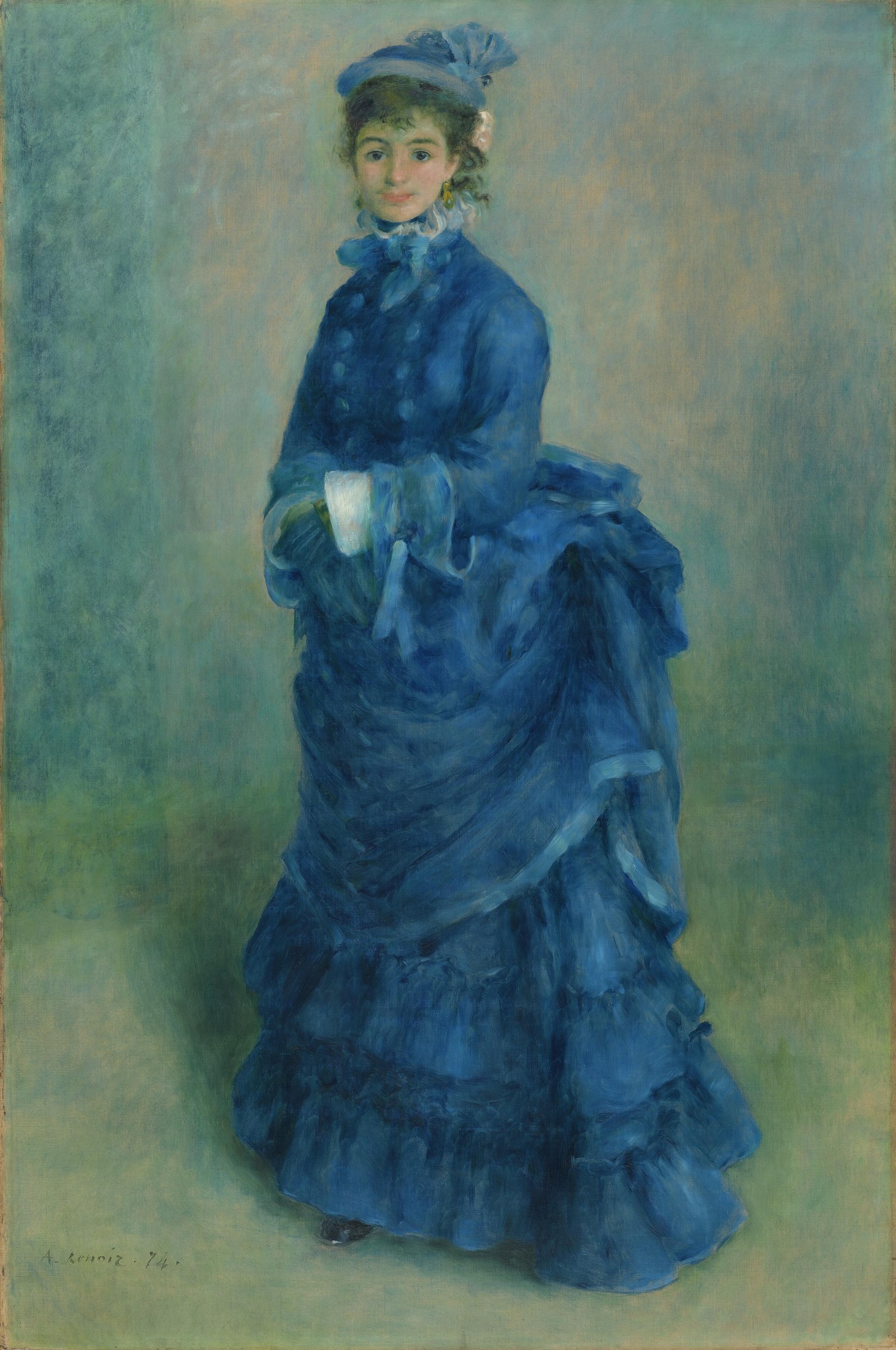
La Parisienne is a painting with almost nothing in it but a woman in blue. No street, no room, no landscape. Only a soft, vague background and a young Parisienne in a blue dress, as if she has stepped out for a moment to show herself to us. She holds a glove, tilts her head slightly and smiles ever so faintly. A curl peeks out from under her hat.
Pierre-Auguste Renoir painted La Parisienne in 1874. The model was the young actress Henriette Henriot, who posed for Renoir for other pictures in these years too. Renoir does not tell a story. He shows fashion, grace and that particular Parisian charm that novelists wrote about.
Look at the blue. It is not one blue but dozens: dark, light, silvery, almost violet. The dress is built from colour, not from outlines. The background is soft grey-beige, so the blue sounds even stronger. In this way Pierre-Auguste Renoir turns a fashionable portrait into a painting about colour itself.
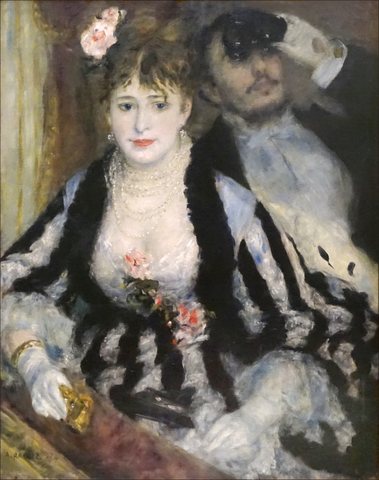
La Parisienne was shown in 1874 at the first Impressionist exhibition, together with La Loge. Decades passed before it found its home. In the early twentieth century two sisters from Wales, Gwendoline and Margaret Davies, built one of the finest Impressionist collections in Britain. Among their paintings was La Parisienne.
Today La Parisienne is in the National Museum Cardiff in Wales, to which the Davies sisters left their collection. There it is affectionately called "The Blue Lady". She still stands alone against her soft background, dressed in blue, greeting us from nineteenth-century Paris.
Interesting facts
The painting was modelled by the actress Henriette Henriot.
La Parisienne is among the paintings Renoir showed at the first Impressionist exhibition in 1874.
The painting belongs to the Davies sisters' collection in the National Museum Cardiff, where it is called "The Blue Lady".