The Large Bathers
The story
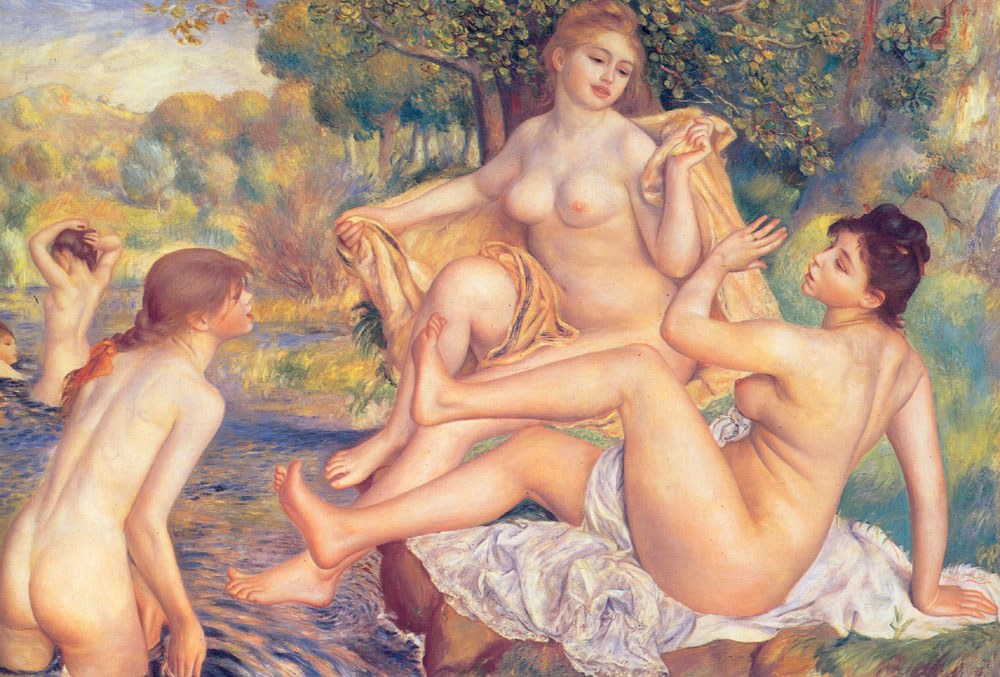
The Large Bathers is the painting the artist struggled with for three whole years. On the bank of a stream, in green shade, naked young women are resting. One sits and laughs, another leans back, and a third splashes water at her friends, who pull away with a shriek. The scene is playful, but it is painted in a new way: the bodies have a clear, clean outline, are smooth as marble and seem to glow from within.
After his journey to Italy, Pierre-Auguste Renoir no longer wanted to paint only fleeting impressions. He wanted form, line and permanence, like the old masters. For The Large Bathers he made dozens of drawings and studies, something the Impressionists hardly ever did. He also looked for inspiration in a seventeenth-century stone relief in the gardens of Versailles, showing nymphs bathing in a stream.
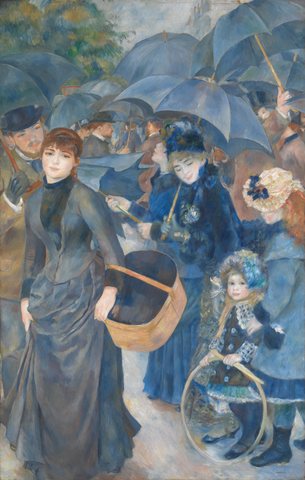
This change had already begun in The Umbrellas, and here it reaches its peak. Pierre-Auguste Renoir leaves behind the quick patches of light and paints clearly, carefully, almost like a sculptor. The landscape behind the women stays soft, while the bodies themselves are firm and pure. The clash of the two styles gives the picture a strange, fairy-tale light.
In 1887 Renoir showed The Large Bathers in Paris. Opinions were divided. Some friends thought he had abandoned Impressionism; others saw the beginning of something new and bold. He himself was not fully satisfied, and soon afterwards returned to a warmer, softer style, visible in Girls at the Piano. But without the years of The Large Bathers that mature style would never have been born.
Today The Large Bathers is in the Philadelphia Museum of Art. It is one of Renoir's most ambitious paintings and a bridge between Impressionism and classical art. The women on the bank still laugh and splash water, forever young in their green shade.
Interesting facts
Renoir worked on The Large Bathers for about three years and made many preparatory drawings for it.
The composition was inspired by a stone relief of bathing nymphs in the gardens of Versailles.
Today the painting is in the Philadelphia Museum of Art.