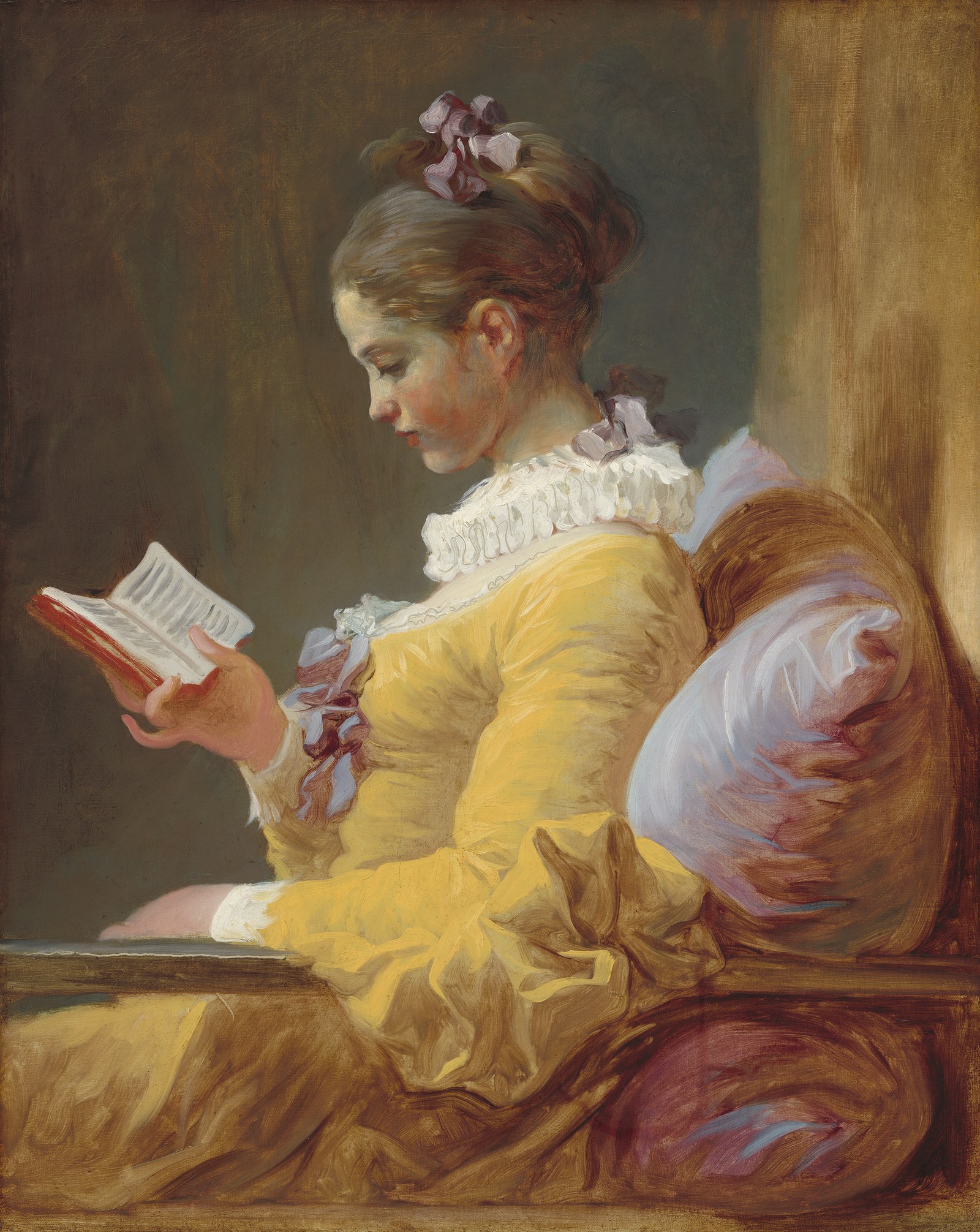
Full lesson: Young Girl Reading
The full version of the lesson: 12 steps, a map with 14 zones and a recipe for every colour, close-ups of the difficult areas and a print pack. Tick off the steps as you paint. The site remembers how far you have got.
Zone map
The picture is divided into 14 zones. The number shows the order in which they are painted. Point to a zone to see its colour, recipe and how to paint it.
1. Background
#4D4131darker #47392Clighter #544938Recipe: raw umber + ultramarine + yellow ochre
Brush: No. 16 flat
Cover solidly with a thin layer and strokes in different directions. Around the profile leave the background slightly lighter and cooler so the face stands out.
2. Wall on the right
#8B6D41shadow #6C5230light #AB8D5FRecipe: burnt sienna + yellow ochre + a little raw umber
Brush: No. 16 flat
Long vertical strokes from top to bottom. The light comes from the left, so the left edge of the wall is lighter.
3. Chair back
#6D422Ashadow #4B241Elight #916944Recipe: burnt sienna + burnt umber; for the light add yellow ochre
Brush: No. 10 flat
Paint with curved strokes following the shape of the chair back. It is darkest at the bottom, where it meets the cushion.
4. Lower cushion
#6F3F2Dshadow #4D251Fhighlight #9A8FA0Recipe: burnt sienna + alizarin + a little umber; highlights are white + ultramarine + alizarin
Brush: No. 16 flat
Broad curved strokes. The grey-blue highlights go on last, one stroke each.
5. Ledge
#5A452Flight edge #B1A78CRecipe: raw umber + yellow ochre; the edge is white + ochre + a touch of ultramarine
Brush: No. 10 flat
The light edge is one straight stroke from left to right. Do not correct it.
6. Cushion
#C7B3CFshadow #926F5Blight #E6DFE8Recipe: white + alizarin + ultramarine; for the shadow add umber
Brush: No. 16 flat
The strokes follow the rounded shape of the cushion. It is lightest at the top left and darkest at the bottom right.
7. Dress
#C9A03Cshadow #9B7846deep shadow #714C2Clight #E6C45ARecipe: yellow ochre + Naples yellow; shadow: ochre + sienna + a touch of umber; light: Naples yellow + white
Brush: No. 16 flat, then No. 10
First the whole block in the main colour, then the shadows in the folds. Never darken with black, or the yellow turns dirty.
8. Sleeve
#B1915Bshadow #6F593Fcuff #D7CEB5Recipe: yellow ochre + a little burnt sienna; the cuff is white + ochre
Brush: No. 10 flat
The sleeve is built from a few long diagonal strokes. Each stroke is one movement.
9. Hair
#5E4735dark #452E25highlight #7A6751Recipe: burnt umber + burnt sienna; highlights are ochre + white
Brush: No. 6 round
The strokes follow the direction of the hair: from the forehead back to the bun. The highlights are thin and few.
10. Face and neck
#C79A74light #E9C2A0shadow #8B694ARecipe: white + yellow ochre + a touch of cadmium red; cheek: a little more red; shadows: ochre + sienna
Brush: No. 6 round
Soft transitions. Lightly blend the border between light and shadow with a clean dry brush.
11. Hands
#D2A07Eshadow #9D684Alight #EBC8AERecipe: as the face, but a little warmer: more red in the fingers
Brush: No. 6 round
The fingers are simple shapes. Do not paint nails or creases, only the light and the shadow.
12. Book
#E8E2D2page shadow #A38F7Bcover #8C3A24Recipe: pages: white + a touch of ochre; cover: burnt sienna + cadmium red
Brush: No. 6 round
The pages are a few quick light strokes. The red edge is one long line.
13. Collar
#ECE6D6shadow #BAAE90darkest #746851Recipe: white + a touch of ochre; shadows: white + ochre + a touch of umber
Brush: No. 6 and No. 2 rounds
Short, curly movements. First the shadows, then pure white on top.
14. Ribbons
#9A6B85light #C7B3CFdark #563C33Recipe: alizarin + white + a little ultramarine
Brush: No. 6 round
3–4 strokes per ribbon and that is all. They are in three places: in the hair, at the neck and on the sleeve.
My progress
A warm ground on the canvas
Cover the whole canvas with burnt sienna, well thinned. Wipe off the excess with a rag until an even honey-brown layer remains. Let it dry to the touch.
On a white canvas it is hard to judge values. The warm ground is the middle value of the picture, and everything else goes darker or lighter than it.
- The layer must be thin and transparent, not solid.
Small gaps in the ground are not a mistake. Fragonard lets the warm ground show between the strokes.
Grid sketch
Draw a pencil grid: 6 squares across and 7½ down. On a 40 × 50 cm canvas each square is 6.7 cm. Print the A3 outline with grid from the pack and transfer it square by square.
Start with the big lines: the chair back, the back, the ledge. Only then the head, the hand and the book.
- The head is an oval tilted down towards the book. The whole slant of the picture comes from it.
- Check the angle of the book against the grid. It is higher on the left.
The sketch is only a map. If something is off, you will fix it with paint.
Values in one paint
With burnt umber and thinner only, paint the dark areas: the background, the shadow under the ledge, the folds of the dress and the chair back. Work with a No. 10 flat.
Wipe the light areas (the collar, the front of the dress, the cushion) back to the ground with a rag. This way you already see the whole picture in light and dark.
- Squint at the original. Only the big values remain.
If the picture "works" here, colour will only finish it.
The background and the wall on the right
Now colour begins. You paint from the furthest back to the front. First the background (zone 1), then the wall on the right (zone 2). See the recipes in the zone map.
Cover with a No. 16 flat. Go slightly into the outline of the head and back. Later you will cover them with the colour of the hair and dress, and the edge will be clean.
- The paint is still lean: more thinner, little oil.
The chair back, the lower cushion and the ledge
These three zones are the dark, warm browns around the girl. Paint the chair back (zone 3) with curved strokes, the lower cushion (zone 4) with broad ones and the light edge of the ledge (zone 5) with one straight stroke.
- Do not add the highlights on the lower cushion yet. They come in step 10.
The cushion behind her back
The cushion (zone 6) is the largest light block next to the dress. Mix white, alizarin and a little ultramarine into a grey-violet. Cover the whole shape in one colour, with strokes following the curve.
- Compare it with the yellow of the dress in the original. The violet and the yellow strengthen each other.
The dress and sleeve: the big yellow block
The dress (zone 7) and the sleeve (zone 8) are the heart of the picture. Cover them with the main yellow from the recipe: yellow ochre and Naples yellow. For now just mark the shadows in the folds with a little sienna.
- Do not darken the yellow with black. The shadow is ochre with sienna.
- Leave the cuff of the sleeve light.
The hair, face and hands: first blocks
The hair (zone 9) in dark brown, the face and neck (zone 10) and the hands (zone 11) in one warm flesh colour. No cheeks and no details yet. Only the shape and one value.
- Watch the line of the profile: forehead, nose, mouth and chin. It matters more than anything else in the face.
The book, collar and ribbons: the last blocks
The last three zones: the book (zone 12), the collar (zone 13) and the ribbons (zone 14). Now the whole canvas is covered and looks like the picture in step 9.
Take a break here. Let the layer dry to the touch before you continue.
- For now the collar is one light block, without curls.
Step back 3 metres and look at the canvas. If the big blocks are in place, the hardest part is behind you.
Form and light in the dress and cushion
The light comes from the left and above. Where the dress turns towards us, add Naples yellow and white. Where it turns away, add ochre with a touch of umber.
On the cushion add the light at the top left and the shadow at the bottom right. On the lower cushion add the grey-blue highlights.
- The paint is now thicker and has more oil. The rule is fat over lean, never the other way round.
- Work with a No. 10 flat and leave the strokes visible.
The face and hands up close
This is the most delicate step. See the close-ups "The face" and "The hand with the book" below. Model the face softly with a No. 6 round: the cheek and nose are white with a touch of cadmium red, the shadows under the chin are ochre with sienna.
In the hair add a few thin highlights following the direction of the strands.
- The eye is just one dark line, looking down. Do not paint a pupil.
- The mouth is a small red patch, not a line.
If the face looks "hard", lightly pass a clean dry brush over the border between light and shadow.
Fragonard's final strokes
This is the best part. The sleeve: load a No. 10 flat with plenty of paint and make a few long diagonal strokes, each in one movement. Do not go back to correct them.
- The collar: short curly movements in pure white. You can scratch lines into the wet paint with the brush handle.
- The ribbons: 3–4 strokes each and that is all.
- The book: the red edge in one line, the pages in almost white.
- Finally the brightest highlights on the collar, dress and cushion with a No. 2 round.
Stop before you feel the urge to "finish" everything. The strength of this picture is that it looks painted in one breath.
Up close
The three most difficult areas, each in three stages: blocks, forms and original.
The face
The face is in profile and bent towards the book. All the light falls on the forehead, cheek and nose. The ear, neck and chin are in warm shadow.
- Start with the line of the profile, then the light patch of the cheek.
- The cheek is white, ochre and a touch of cadmium red.
- The eye is one dark line, without a pupil.
- The border between the face and the background is soft. Do not outline it.
The hand with the book
The book is small and held in one hand. The pages are the lightest spot in the left half of the picture, so the background around them must be dark.
- The pages: a few quick strokes of almost white, with thin grey lines for the text.
- The cover: burnt sienna and cadmium red; the red edge is one line.
- The fingers: simple shapes, warmer at the tips.
- The thumb rests on the page. It is light on top and in shadow below.
The collar
The collar is gathered lace. Fragonard does not paint every fold; he gives a feeling of curls with quick movements.
- First the greyish shadows between the curls: white, ochre and a touch of umber.
- Then pure white on top, with short curly strokes.
- Here and there scratch into the wet paint with the brush handle.
- The lower edge of the collar casts a thin shadow on the dress.