Where Do We Come From? What Are We? Where Are We Going?
The story
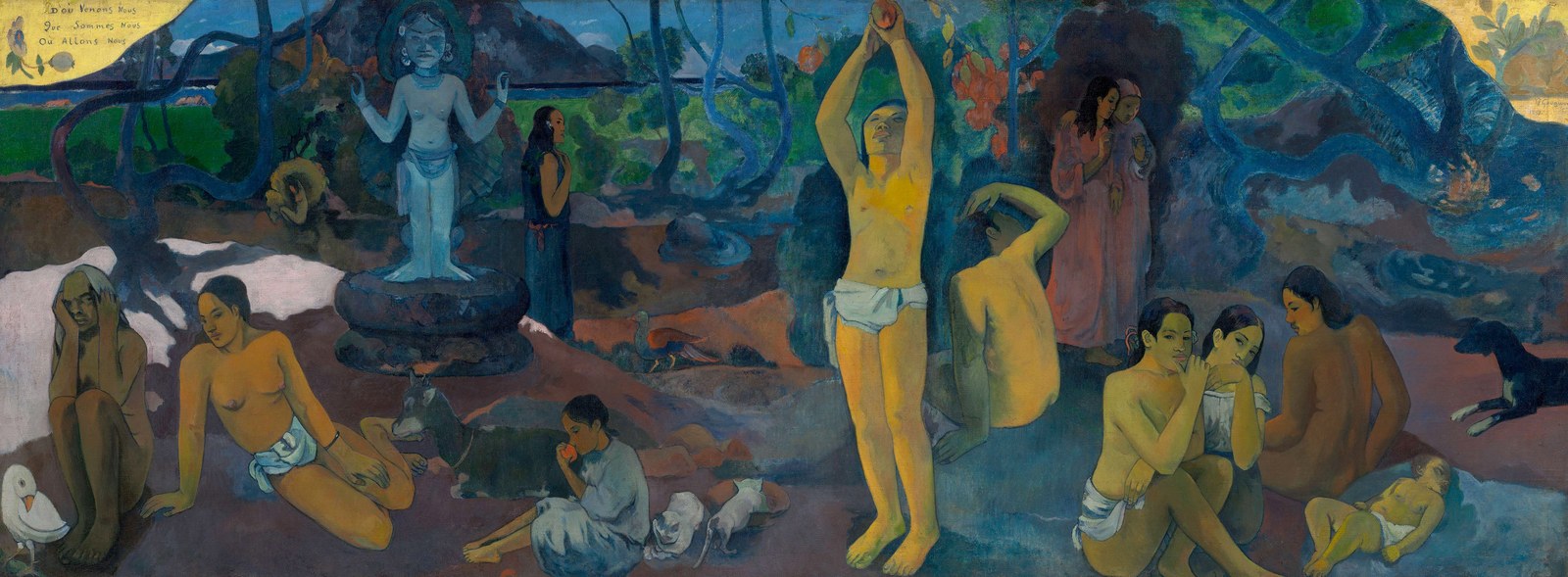
“Where Do We Come From? What Are We? Where Are We Going?” is the largest painting by Paul Gauguin. He painted it on Tahiti in 1897–1898, in his hardest years: ill, poor and devastated by the death of his beloved daughter Aline. Gauguin believed that this was his last and most important work.
“Where Do We Come From? What Are We? Where Are We Going?” is read from right to left. On the right is a baby, the beginning of life. In the middle a young person picks fruit from a tree. On the left sits an old woman, huddled, with her hands to her face: the end. Behind them a blue idol raises its arms. The title is written by the artist himself in the upper left corner.
Paul Gauguin painted the picture in about a month, on coarse canvas, almost without preparatory sketches. He wrote that he had put into it all his energy and pain. The colours are dark blue and green, with warm bodies like islands in the night.
The painting was shown in Paris in 1898. Gauguin never fully explained it and said it was like music, not like an answer. In the same year he also painted Nevermore, also full of sadness.
Today “Where Do We Come From? What Are We? Where Are We Going?” is in the Museum of Fine Arts in Boston, which bought it in 1936. Paul Gauguin gives no answers, but asks the three questions that a person asks all their life.
Interesting facts
The canvas measures 139 × 374.6 cm, oil.
The painting is read from right to left, from birth to old age.
The museum in Boston bought the painting in 1936.