Paint Path Leading through Tall Grass Yourself
Path Leading through Tall Grass
Five steps from a blank canvas to the finished picture. For each step you see how far to go, which brush to use and where to start. Drag the line across the picture to compare the step with the original.
Path Leading through Tall Grass is a summer landscape by Pierre-Auguste Renoir from around 1876, the brightest years of Impressionism. This oil painting lesson is for beginners and for anyone who wants to understand how Renoir painted grass without a single clear blade: a light ground, a few large blocks and many quick, broken strokes. You need a canvas, nine paints and five brushes.
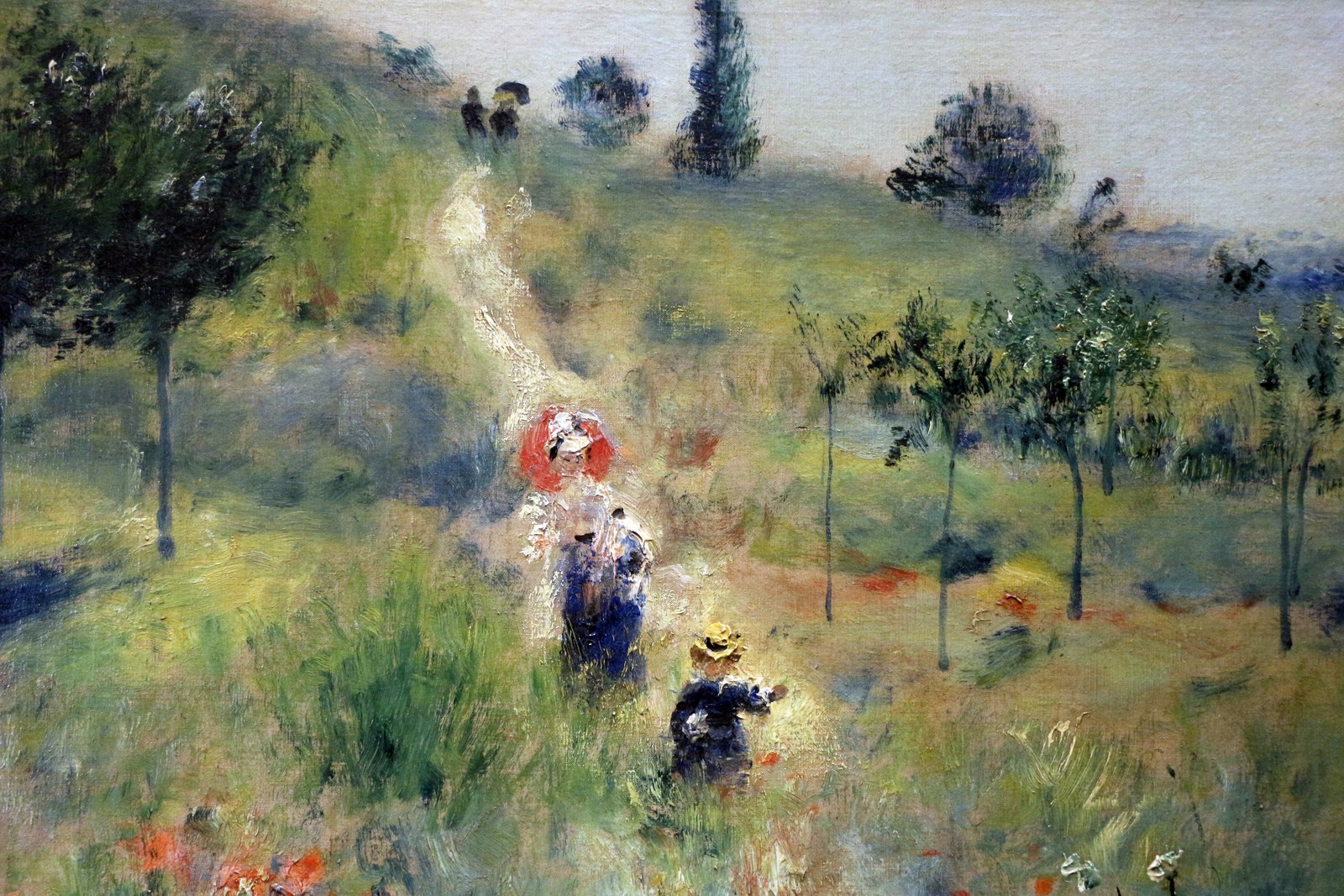
 Path Leading through Tall Grass
Sketch
about 45 minutes
Sketching Path Leading through Tall Grass on a light ground
Here the ground is light, not dark. The Impressionists painted on light canvases so the paint would glow like air. Cover the canvas very thinly with white and a touch of Naples yellow, well thinned, and let it dry.
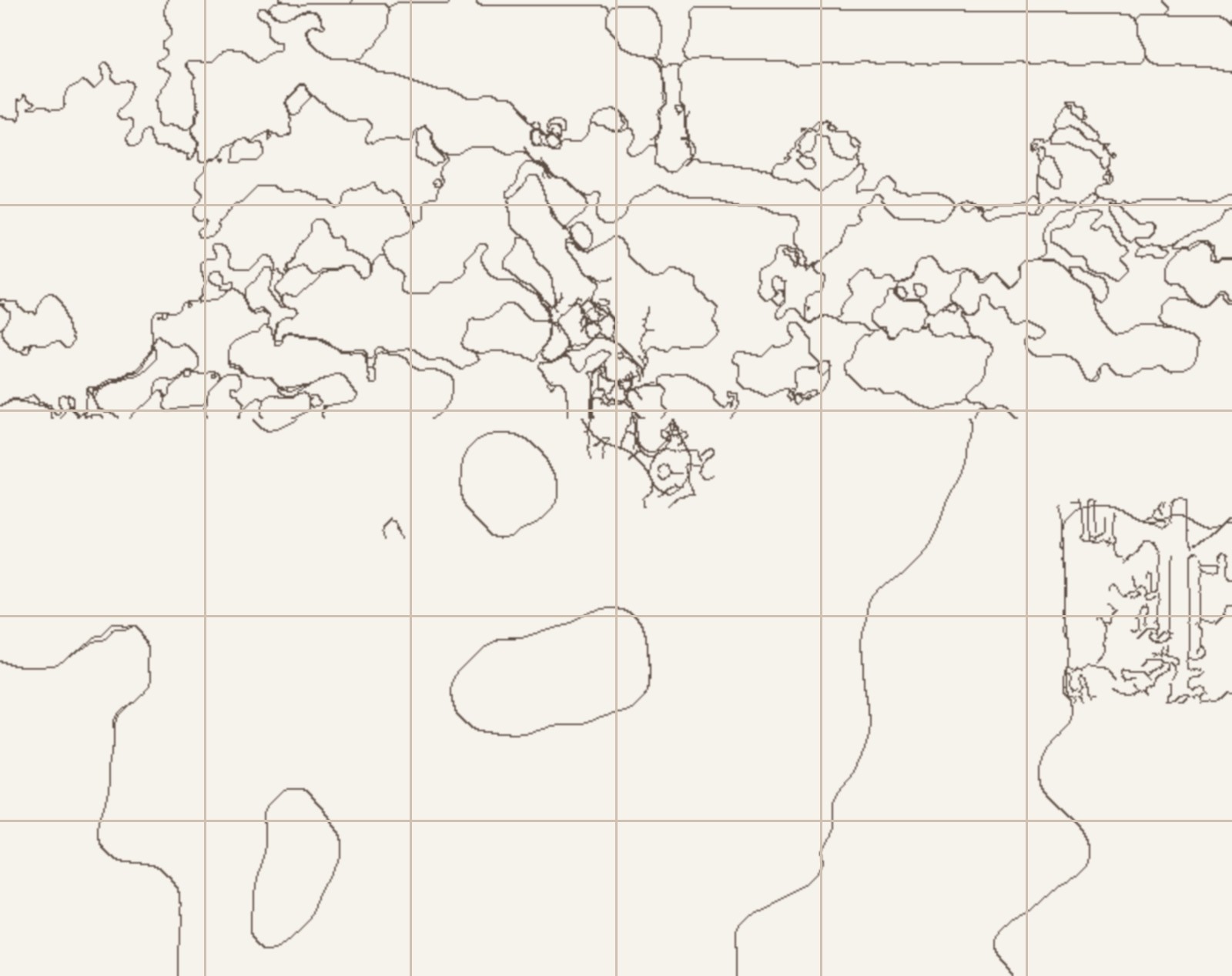
Draw a pencil grid: 6 squares across and almost 5 down. On a 50 × 40 cm canvas each square is 8.3 cm. Transfer only the big lines: where the hill ends and the sky begins, the path that comes down like the letter S from the top to the bottom edge, the groups of trees left and right, and the fence on the right edge.
- The woman with the parasol and the child are small. Mark them with just two or three lines and a small circle for the parasol.
- Draw nothing in the grass. There are only patches there, and they will come with the paint.
Be careful where you place the path. It leads the eye from the foreground to the two people at the top of the hill. If it is in the right place, the picture will "work" even before it has colour.
about 45 minutes
The lights and darks of the picture
Mix ultramarine with a little burnt sienna and plenty of thinner. You get a dark grey-blue to paint the four values you see in the picture. The darkest are the trees at the top left, the shadows under them and the fence on the right. The lightest are the sky, the path and the light patches of grass in the middle.
Work with a No. 16 flat and thin paint. Do not paint the light areas. Let the light ground show through.
Squint at the original. The grass stops being "thousands of blades" and becomes a few large patches of light and dark. That is exactly what you paint now.
about 1½ hours
The big colour blocks: sky, trees, hillside
Start with the sky: white with a little ultramarine and a touch of ochre. Then the dark trees with viridian, ultramarine and a little burnt sienna. Then the hillside: a warm yellow-green in the upper half and a cooler blue-green towards the bottom. Cover with a No. 16 flat and do not worry about shapes.
- Use a single colour in each block. No blending and no detail.
- There is no black here and almost no brown. The shadows in this landscape are blue and green, not grey.
Compare your canvas with the picture. If the sky is lightest, the trees darkest and the hillside in between, all the hard decisions are already made.
2–3 hours
The grass, the shadows and the two figures
Now comes the grass. Load a No. 8 filbert and paint short, quick strokes in different directions, the way grass sways in the wind. In the light areas mix cadmium yellow, white and a touch of viridian. In the shadows mix viridian with ultramarine. Lay the strokes side by side and do not blend them.
The shadows under the trees are blue-violet: ultramarine, a touch of alizarin and white. Then paint the figures with a No. 4 round. The woman's dress is dark blue, and the child is a small dark patch with a white hat.
- The paint is now thicker and has more oil. The rule is fat over lean, never the other way round.
- The path is light but not white. Put a little pink and yellow into it.
about 1 hour
The poppies and Renoir's last strokes
Now the colour everyone remembers appears. Take pure cadmium red light with a No. 4 round and place the poppies as small fiery dots. Most of them are on the left, in the middle of the foreground. Each dot is one stroke. Do not paint them as flowers but as sparks.
- The parasol: red with a touch of alizarin, one or two round strokes.
- The white flowers in the grass: a few dots of almost pure white with a No. 2 round.
- The fence on the right: a few vertical dark strokes, without straightening them with a ruler.
- Finally add a few of the lightest strokes along the path and on the light grass.
Stop before you feel the urge to "finish" the grass. Renoir does not paint blades; he paints movement and light. The less you correct, the more alive it stays.
What you need
Canvas — 50 × 40 cm, primed
Brushes — flats No. 16 and No. 10, filbert No. 8, rounds No. 4 and No. 2
Thinner — odourless
Oil — linseed
Palette and rag — cotton
Time — about 6–7 hours, in 2–3 sessions
Paints
Titanium white — plenty
Cadmium yellow light
Naples yellow
Yellow ochre — a little
Viridian
Ultramarine
Cadmium red light — for the poppies
Alizarin crimson — a little
Burnt sienna — a little
The painting's colours
#A9B2B4#8D9BA0#263A47#3E5759#637B76#838C61#B0AB94#4F5A71#C8503A