The Raising of the Cross
The story
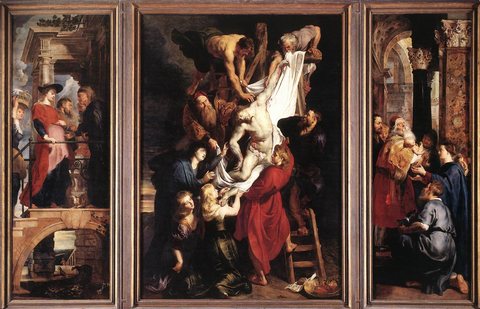
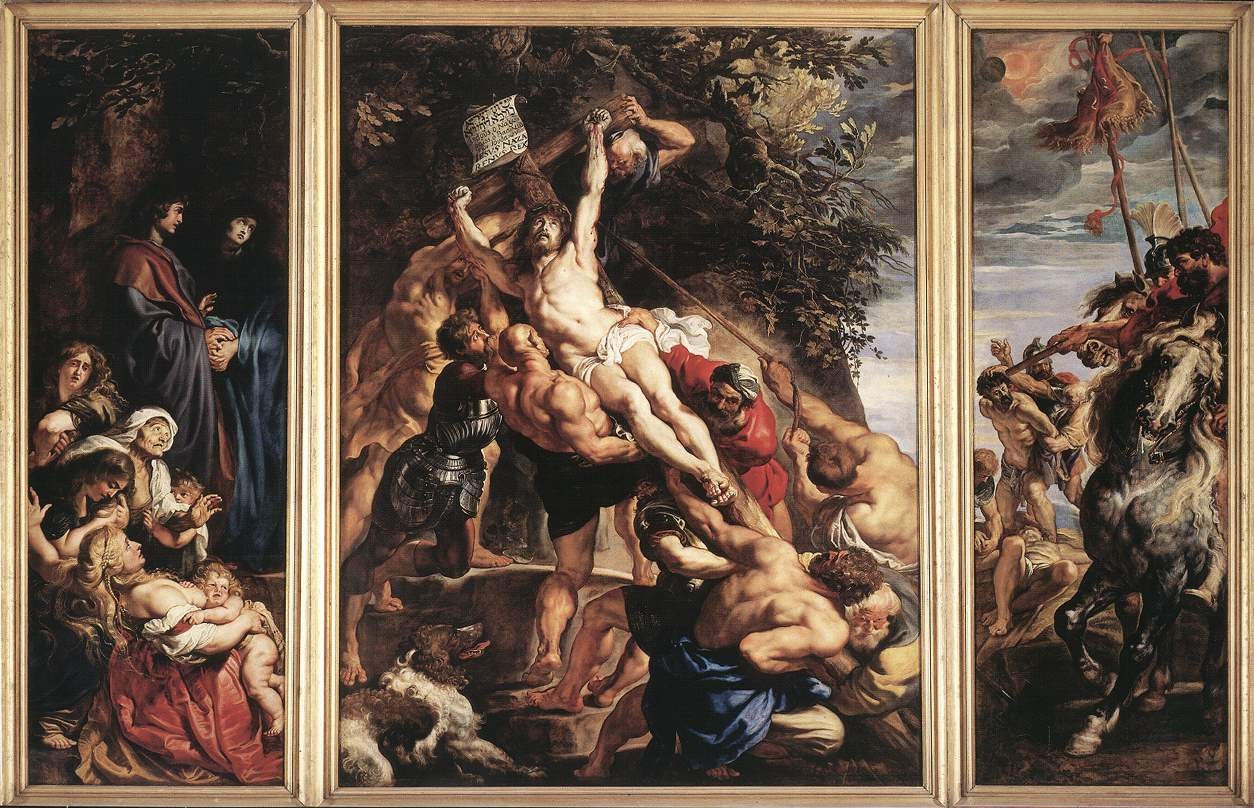
“The Raising of the Cross” was painted in 1610–1611 for a church in Antwerp. Peter Paul Rubens had just returned from Italy and wanted to show everything he had learned there. It is a huge altarpiece in three parts.
In the centre of “The Raising of the Cross” a group of strong men strain with all their might to raise the heavy cross with Christ. Their bodies are twisted, their muscles taut. The cross runs diagonally across the whole picture. In the left wing Christ's loved ones weep, and in the right wing Roman soldiers sit on horses.
Peter Paul Rubens does not paint a calm scene. He makes us feel the weight and the movement, as if the cross were rising before our eyes. The light falls on the white body of Christ, and around him it is dark. Here we can see how much he learned from the great Italian masters.
After this painting Rubens became the most sought-after painter in Antwerp. A little later he also painted The Descent from the Cross for the cathedral. In 1794 French soldiers carried both paintings off to Paris, and they returned to Antwerp in 1815.
Today “The Raising of the Cross” is in the Cathedral of Our Lady in Antwerp. Peter Paul Rubens turned one of the saddest scenes in the Bible into a painting full of strength and movement.
Interesting facts
The central panel is about 4.6 m high.
In 1794 the French took the painting to Paris; it returned in 1815.
The altarpiece was painted for the church of Saint Walburga and later moved to the cathedral.