Aristotle with a Bust of Homer
The story
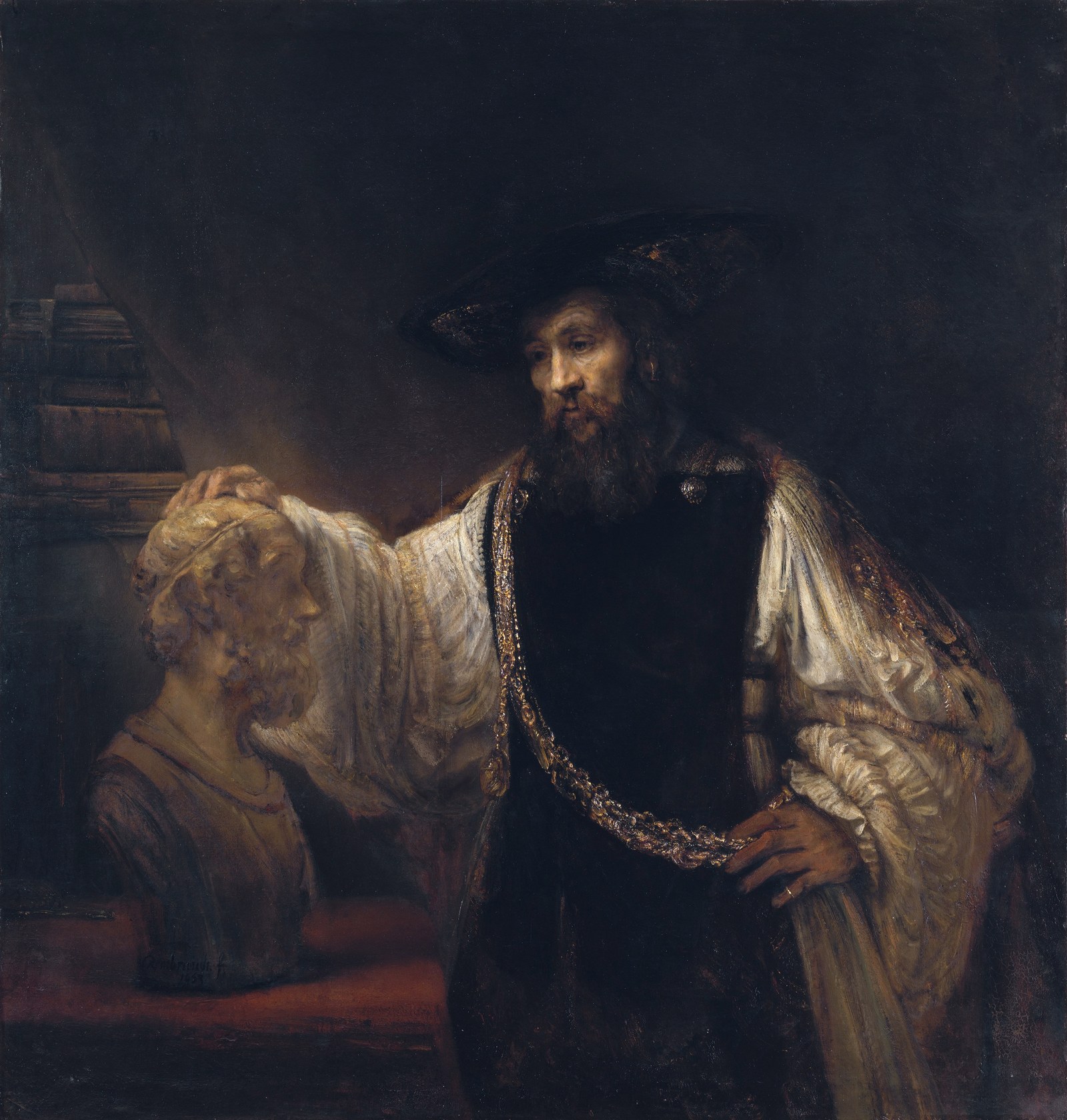
“Aristotle with a Bust of Homer” was painted in 1653, commissioned by Don Antonio Ruffo, a nobleman from Messina in Sicily. Rembrandt was in the midst of his difficult years, but the wealthy collector from the other end of Europe wanted a painting from him in particular.
In “Aristotle with a Bust of Homer” the philosopher stands in shadow, dressed in wide white sleeves and a black garment, with a large hat. His right hand rests on the marble bust of the blind poet Homer. On his chest hangs a gold chain with a medallion showing Alexander the Great, his pupil. His face is thoughtful, his gaze turned somewhere inward.
In this way Rembrandt brings three people together in one painting: the poet, the philosopher and the general. Aristotle seems to ask himself what is more precious, the fame and gold of the chain or the wisdom of the old poet. The light falls on the bust and the hand, while the face is half lit.
In 1961 the Metropolitan Museum of Art in New York bought “Aristotle with a Bust of Homer” at auction for 2.3 million dollars. At the time this was the highest price ever paid for a painting at auction. Thousands of people came to see it in the very first days.
Today “Aristotle with a Bust of Homer” is in the Metropolitan Museum of Art in New York. Rembrandt painted it while his own life was falling apart, and perhaps that is why there is so much quiet wisdom in it.
Interesting facts
The canvas measures 143.5 × 136.5 cm, oil.
The Metropolitan Museum bought the painting in 1961 for 2.3 million dollars.
The medallion on the chain shows Alexander the Great.