Danae
Hikâye
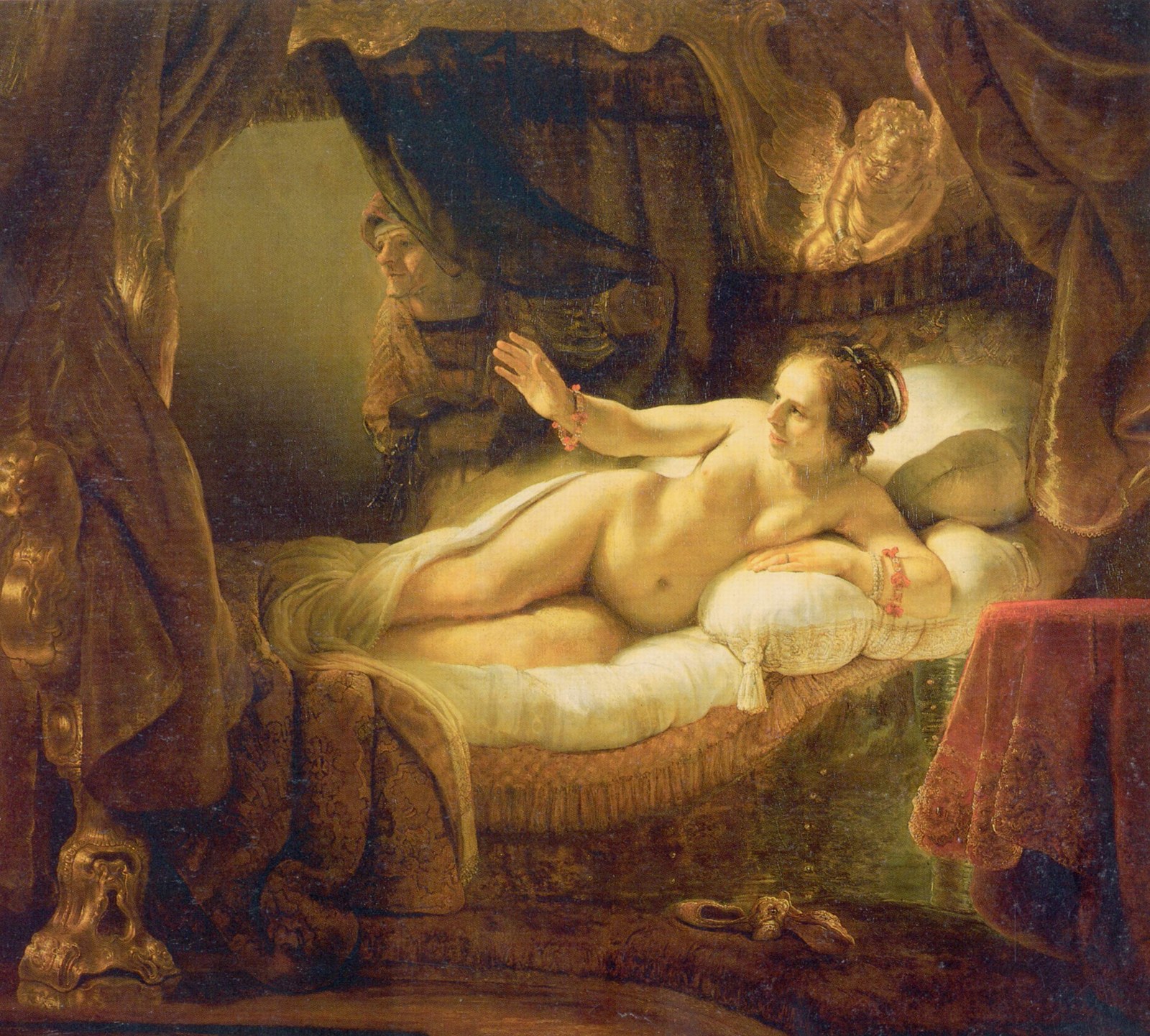
“Danaë” is one of the largest and best-loved paintings by Rembrandt. He began it in 1636 and reworked it years later. The subject comes from Greek myth: a king locks his daughter Danaë in a tower so that she may never marry, but Zeus reaches her as a golden rain.
In “Danaë” the young woman lies on a large bed and raises her hand towards the light coming in from the left. Rembrandt does not paint a rain of coins, but the warm golden light itself, which falls on the body and the sheets. Behind the curtain an old servant watches, and above the bed a golden cupid with bound hands weeps.
Rembrandt does not paint an ideal marble goddess. His Danaë is a real woman with a soft body and an expectant face. That is why the painting seems so alive. X-rays show that he changed the face and the hand years after the first version.
On 15 June 1985 a visitor to the Hermitage threw acid on “Danaë” and slashed it twice with a knife. Much of the paint ran and darkened. The restorers worked for 12 years to save the painting. In 1997 it was shown to the public again.
Today “Danaë” is in the Hermitage Museum in Saint Petersburg. The Russian Empress Catherine II bought it in 1772. The scars of the attack are still visible up close, but Rembrandt's golden light still falls on the bed.
İlginç bilgiler
The canvas measures 185 × 203 cm, oil.
The 1985 attack was followed by 12 years of restoration.
Catherine II bought the painting in 1772.