Стог (закат)
История
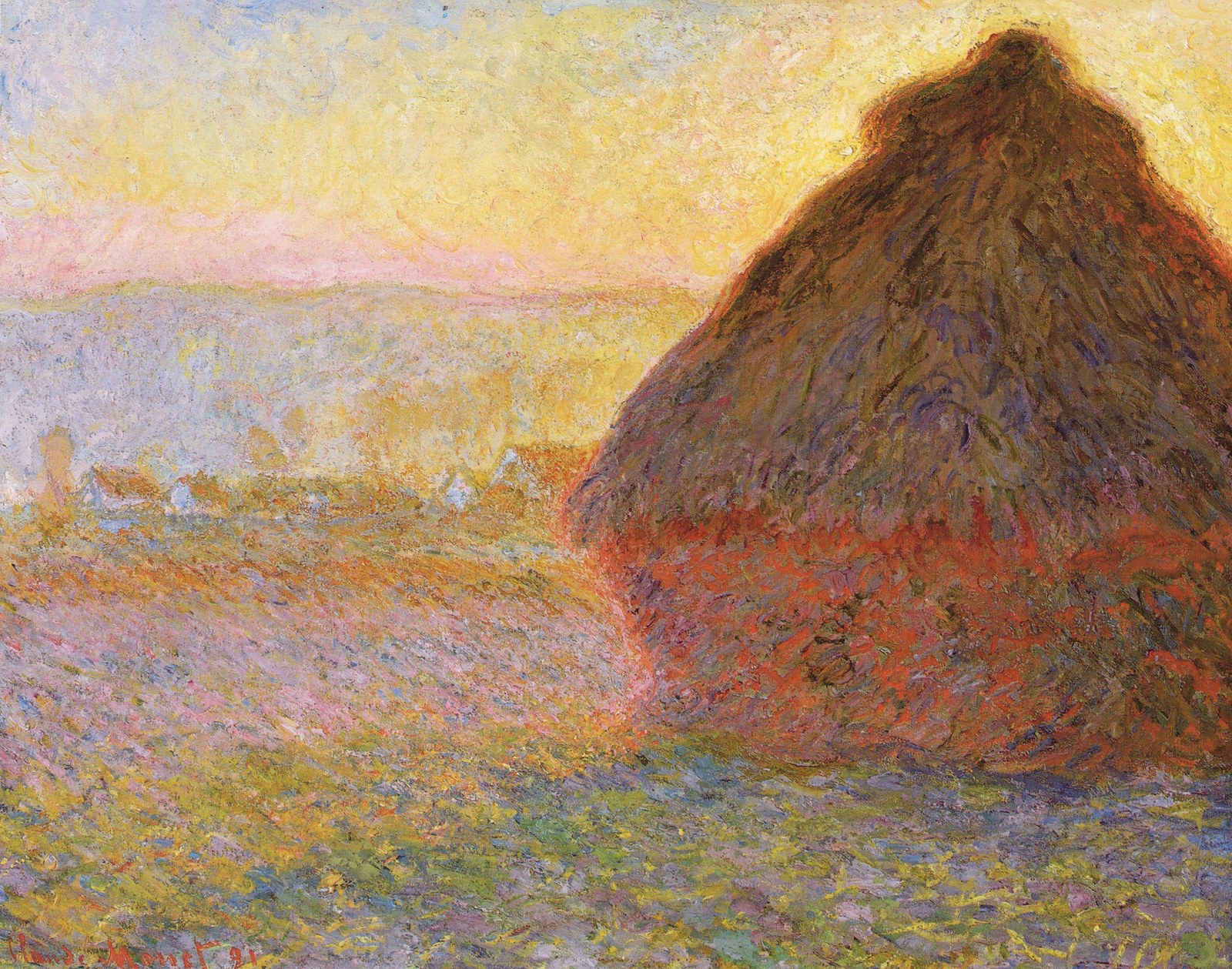
“Grainstack (Sunset)” was painted in 1890–1891 in Giverny, in the field not far from the home of Claude Monet. After the harvest the farmers piled the sheaves into large stacks as tall as a house. Monet saw them every day and decided to paint them again and again while the light changed them.
In “Grainstack (Sunset)” the sun is setting behind the stack, and it seems to burn from within. Its edges glow orange and red, and its shadow is blue and violet. The air is full of a warm golden haze, through which the hills are barely visible. Everything is made of colour and light; there are almost no lines.
They say that Claude Monet went out into the field with many canvases at once, and his stepdaughter Blanche Hoschedé pushed them after him in a wheelbarrow. As soon as the light changed, he put down one canvas and took up another. In this way he painted about 25 pictures of grainstacks: in mist, in snow, in sunshine and at sunset.
In May 1891 the dealer Durand-Ruel showed 15 of them in Paris, and they were sold within days. Five years later the young Wassily Kandinsky saw one of them in Moscow and at first did not understand what was painted; he only felt the power of the colour. Then Claude Monet continued in the same way with Rouen Cathedral, Symphony in Grey and Pink.
Today “Grainstack (Sunset)” is in the Museum of Fine Arts in Boston. In the hands of Claude Monet an ordinary grainstack in a field becomes a way to paint time itself: the hour, the season and the light.
Интересные факты
The canvas measures 73.3 × 92.6 cm, oil.
Monet painted about 25 pictures of grainstacks in 1890–1891.
Kandinsky wrote that a grainstack painting by Monet made him think about the power of colour.