Terraço do Café à Noite
A história
Café Terrace at Night was painted on a September night in 1888, on the very spot you are looking at. Vincent van Gogh set up his easel at the corner of the Place du Forum in Arles, in the south of France, and painted from life, in the dark. A gas lamp glows above the tables, the yellow awning of the café is in front of him, and above the rooftops the sky is full of stars.
This was something new even for him. Until then painters had painted the night in black and grey. Van Gogh wrote to his sister Wil that he had made a night painting with no black in it at all, only beautiful blue, violet and green. Look at Café Terrace at Night and you will see why: the yellow light under the awning makes the blue of the sky even deeper. Here the night is more colourful than the day.
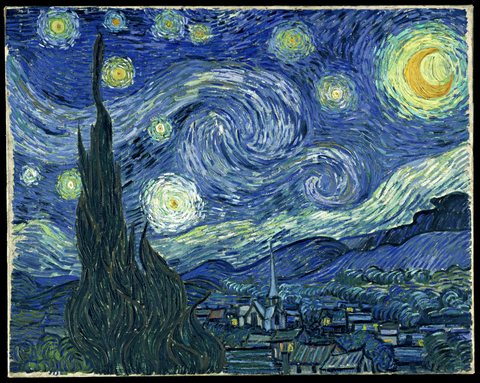
Café Terrace at Night is also the first painting in which his starry sky appears, the sky that would later become his mark. The same month came Starry Night Over the Rhône, and a year later the famous The Starry Night. Much later, astronomers compared the stars in the painting with the sky of that year. Their conclusion is that Vincent van Gogh painted the constellations as they were on the night of 16 or 17 September 1888.
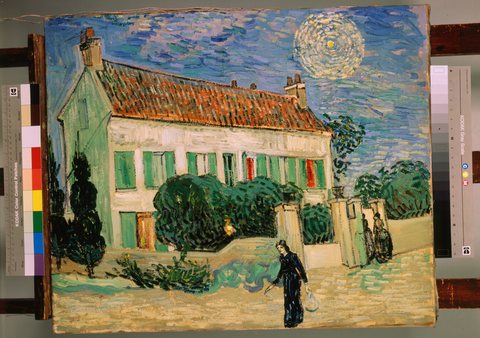
Café Terrace at Night belongs to a happy late summer in Arles. Around the same time Vincent van Gogh also painted The Yellow House, the house where he lived and dreamed of gathering fellow painters. Just days before the terrace, he spent three nights in another café and painted The Night Café: an interior with blood-red walls and a green billiard table. The two paintings are like two faces of the same night, one stifling and restless, the other calm, under the stars.
And who are the people at the tables? Van Gogh asked his sister whether she had read Maupassant's Bel-Ami. The novel opens with a Parisian night and bright cafés full of people drinking. Some researchers go even further. In 2013 a theory appeared that The Last Supper is hidden in the painting: twelve people sit in the yellow halo of light, and among them stands a waiter in white, right beneath a window whose frames form a cross. Whether Vincent van Gogh did it on purpose, no one can say for sure. But just then he wrote to his brother Theo that he felt a great need for religion, and so he went out at night to paint the stars.
The café still exists. In 1990–1991 it was refurbished to look like the painting, and tourists from all over the world stand at the corner of the square where the easel once stood. Café Terrace at Night itself hangs in the Kröller-Müller Museum in Otterlo, the Netherlands. Vincent van Gogh did not sign it. There was no need: no one could mistake it.
Curiosidades
The canvas measures 80.7 × 65.3 cm, oil paint.
At its first exhibition in 1891 the painting was simply called "Café, Evening".
To the right, beside the lit shop, stood the remains of a Roman monument. Van Gogh left them out of the painting.
The café can also be seen in the film Ronin (1998) starring Robert De Niro.