Lekcja anatomii doktora Nicolaesa Tulpa
Historia
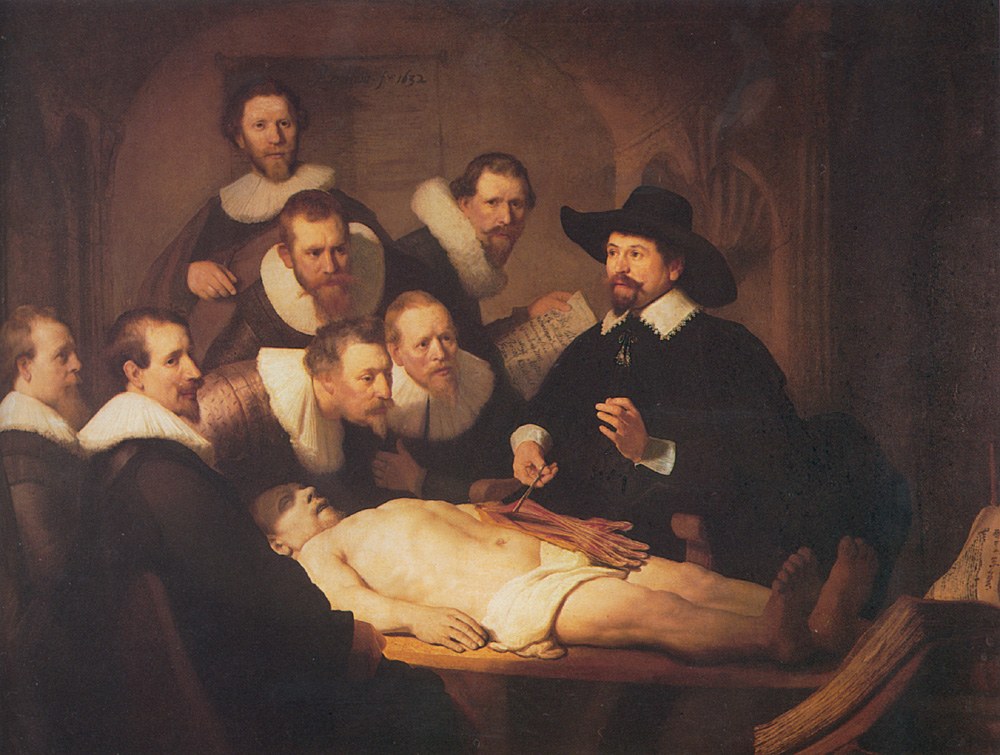
“The Anatomy Lesson of Dr Nicolaes Tulp” is the painting that made Rembrandt famous. It was painted in 1632 in Amsterdam, when he had just arrived in the city. It was commissioned by the surgeons of the city guild, who wanted to be remembered together with the renowned doctor and teacher Nicolaes Tulp.
In “The Anatomy Lesson of Dr Nicolaes Tulp” the body of an executed criminal lies on the table. Dr Tulp, in a black hat, lifts the muscles of the arm with an instrument and shows how the fingers move. With his other hand he makes the same movement. Around him seven men lean in, each in his own way: one looks at the arm, another at the book, a third straight at us.
Public dissections in Amsterdam were events. They were held once a year, in winter, and anyone could buy a ticket. Rembrandt does not paint a textbook but a moment of attention: the light falls on the pale body and the white collars, and everything else sinks into shadow.
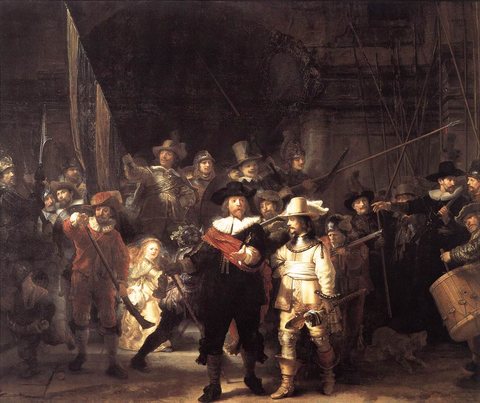
This painting opened the doors of the wealthy homes of Amsterdam. Soon Rembrandt was painting hundreds of portraits, and ten years later he created his largest group painting, The Night Watch. In 1656 he painted another anatomy lesson, The Anatomy Lesson of Dr Joan Deyman, but after a fire only a part of it survives.
Today “The Anatomy Lesson of Dr Nicolaes Tulp” is in the Mauritshuis in The Hague. The King of the Netherlands bought it for the museum in 1828. This is the painting with which a young artist from Leiden became Rembrandt.
Ciekawostki
The canvas measures 169.5 × 216.5 cm, oil.
This was Rembrandt's first large group commission.
The body on the table is that of Aris Kindt, a thief executed that same winter.